Split System vs. Packaged Unit:
Which Is Right for You?
A plain-English breakdown of costs, efficiency, installation, and exactly which system belongs in your home or commercial building — from the HVAC/R experts at Four Elements Service.
If you’re replacing an HVAC system or specifying one for a new building in the Chicagoland area, the choice between a split system and a packaged unit is one of the first and most important decisions you’ll face. Get it right and you’ll have a reliable, efficient system for 15–20 years. Get it wrong and you’ll be dealing with efficiency penalties, higher utility bills, or premature equipment failure.
After 15 years of installing and servicing both types throughout the NW Chicago suburbs — from Buffalo Grove to Schaumburg to Lake Zurich — our team at Four Elements Service has seen every scenario. This guide gives you the same advice we give our customers in person.
You’re in a cold-winter climate (like Chicago), replacing a residential system, have indoor mechanical space, or want the best efficiency and long-term savings.
Your building has a flat roof, no indoor mechanical space, you’re in a mild climate, or lower upfront cost and simpler installation are the priority.


What Is a Split System?
A split system is the most common residential HVAC setup in the United States — and the type we install most often throughout the Chicago suburbs. The name comes from how the system is “split” across two separate units: one inside your home and one outside.
- Indoor unit (air handler): Houses the evaporator coil, blower fan, and — in a gas system — the furnace. Installed in a closet, basement, attic, or utility room. Connects to your ductwork.
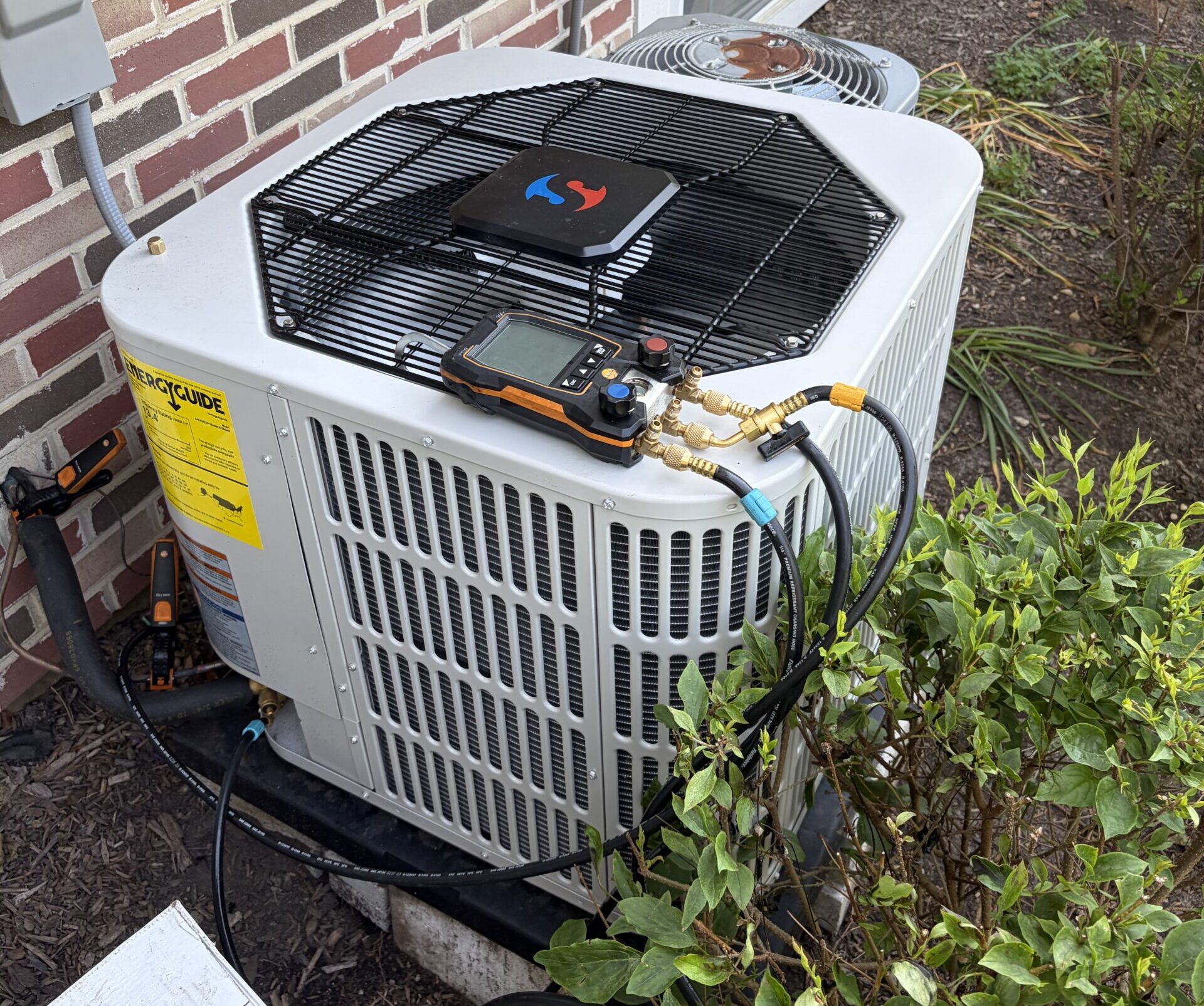
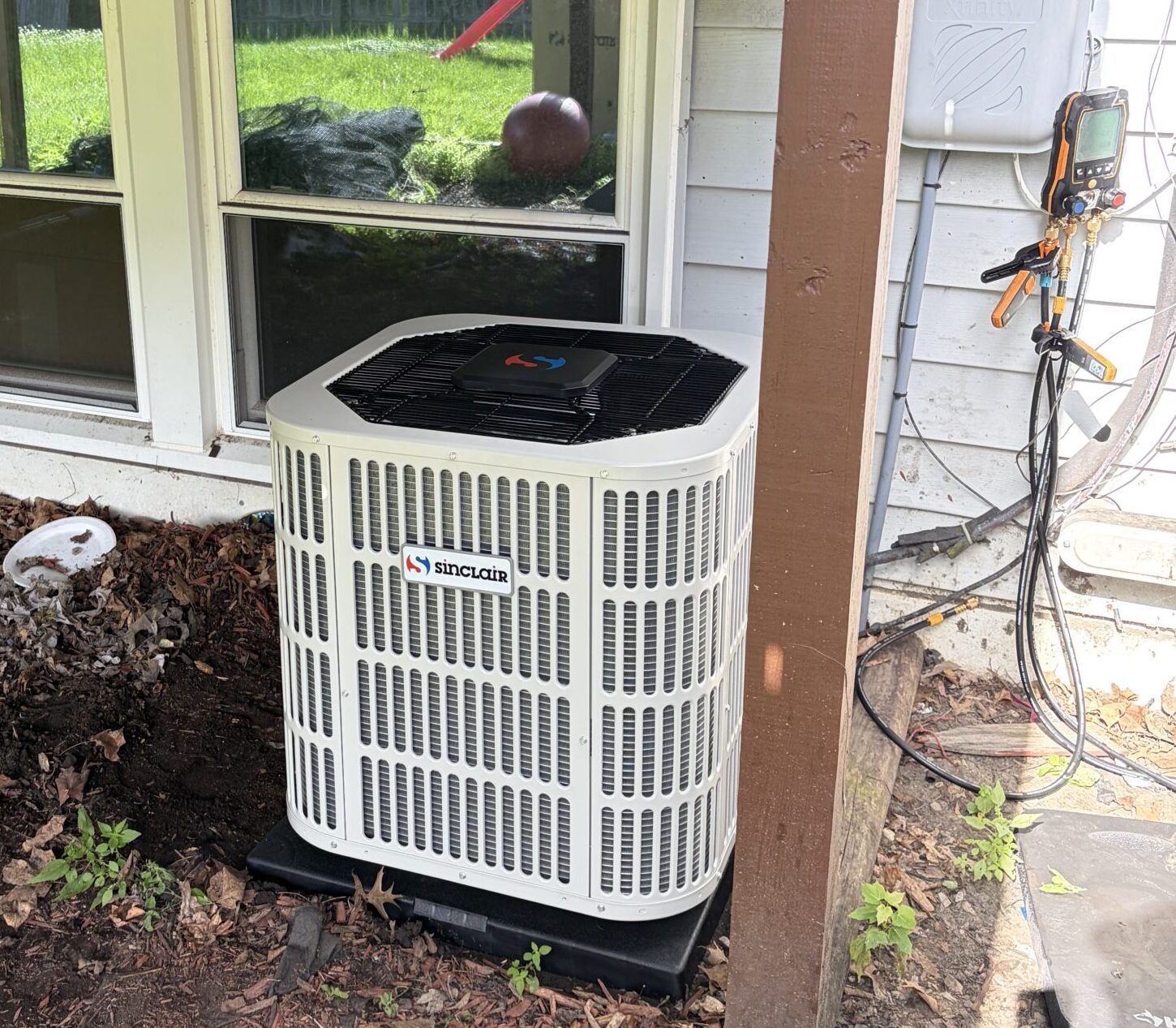
- Outdoor unit (condenser): Houses the compressor, condenser coil, and fan. Sits on a concrete pad outside. Connected to the indoor unit via refrigerant lines and electrical wiring.
- Refrigerant lines (line set): Copper tubing running between the two units, carrying refrigerant that absorbs heat indoors and releases it outside.
Split systems can also be configured as heat pumps — reversing the refrigeration cycle in winter to heat your home as well as cool it in summer. This is an increasingly popular choice in our service area thanks to improved efficiency and available federal tax credits.
What About Ductless Mini-Splits?
A ductless mini-split is a split system variant without ductwork. The outdoor condenser connects to one or more wall-mounted indoor air handlers through a small 3-inch wall penetration. These are ideal for additions, garages, older homes without existing ducts, or specific rooms needing independent temperature control. They consistently achieve the highest SEER2 ratings available — often 20+. We install and service mini-splits throughout the NW Chicago suburbs.
In the Chicago area, where winter temperatures regularly drop below 15°F, a split system paired with a gas furnace is almost always the most practical and efficient choice for residential use. Our winters simply rule out packaged heat pumps for most homes. Learn about our heating system options →
What Is a Packaged Unit?
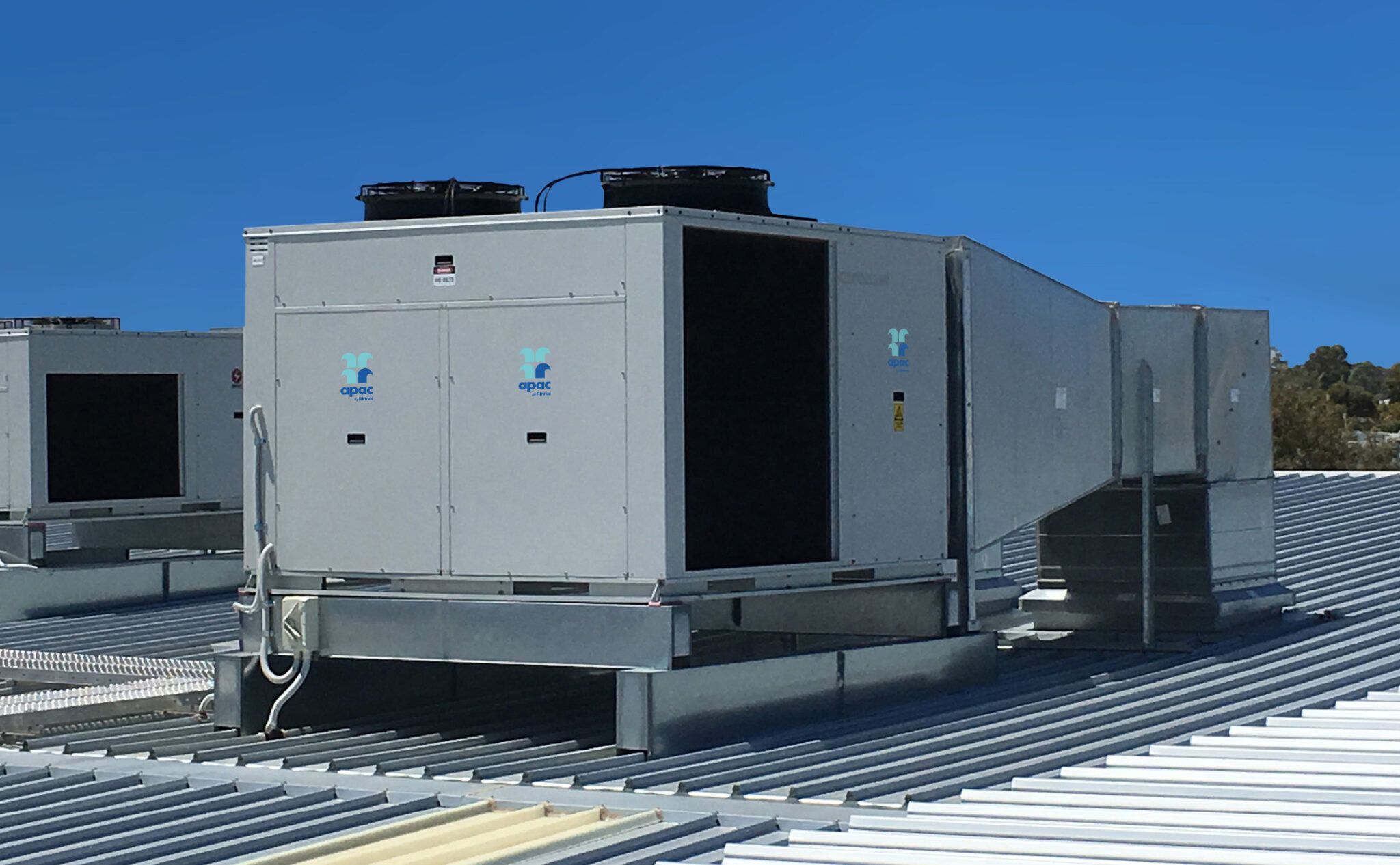
A packaged unit (also called a self-contained unit or packaged system) houses every HVAC component — compressor, condenser coil, evaporator coil, blower fan, and in gas systems the heat exchanger — inside a single outdoor cabinet. There is no separate indoor unit.
Packaged units are installed one of two ways:
- Rooftop units (RTUs): Mounted on flat or low-slope commercial building roofs, with supply and return ductwork dropping through the roof into the building. The dominant HVAC technology for single-story commercial buildings across Chicagoland.
- Ground-mounted units: On a concrete pad at grade level, with ductwork through the wall or foundation. More common in residential use in warm-climate states — Florida, Texas, Arizona — where there’s rarely a need for a large indoor mechanical space.
Because everything is in one cabinet, packaged units are simpler to install and easier to service (one location, one unit). The trade-offs are lower efficiency ceilings and less flexibility for cold-climate applications.
Head-to-Head Comparison
| Category | ✦ Split System | ✦ Packaged Unit |
|---|---|---|
| Installation Cost | Higher (2 units + line set) | Lower (single unit, one location) |
| Operating Efficiency | Higher SEER2 ratings (up to 26+) | Typically SEER2 14–16 max |
| Space Required | Outdoor pad + indoor mechanical room | Roof or ground pad only |
| Cold-Weather Performance | Excellent — gas furnace pairing | Limited — struggles below 35°F |
| Noise (indoors) | Very quiet — compressor is outside | Can be noisier if ground-mounted |
| Ductwork Required | Yes (or ductless mini-split option) | Yes, always required |
| Service Access | Two units to maintain separately | Single unit — everything together |
| Best Application | Residential, light commercial | Commercial flat-roof buildings |
| Typical Lifespan | 15–20 years | 12–17 years |
| Heating Option | Gas furnace or heat pump combo | Gas, electric, or heat pump |
| Customization | High — mix-and-match components | Lower — factory pre-configured |
| Chicago-Area Suitability | Strongly preferred for residential | Best for commercial buildings |
Efficiency: Where Split Systems Pull Ahead
Efficiency is where split systems most clearly outperform packaged units — and in a market like Chicagoland with both hot summers and very cold winters, that gap has real dollar consequences.
Modern residential split systems are available with SEER2 ratings from the regulatory minimum of 13.4 all the way to 26+ for top-tier variable-speed systems like Bryant’s Evolution series. Packaged units typically top out around SEER2 16 for residential applications.
For a typical 3-ton residential system running 1,200 hours per year in the Chicago area, upgrading from SEER2 14 to SEER2 18 saves approximately $200–$300 per year on electricity. Over a 15-year equipment life, that’s $3,000–$4,500 in savings — often more than the upfront cost difference between the system types. Add available federal tax credits (up to $2,000 for qualifying heat pumps) and the numbers favor split systems even more.
Why the gap? In a packaged unit, the evaporator coil — which should stay cold to absorb indoor heat — sits in the same outdoor cabinet as the hot condenser. Split systems keep the evaporator inside the conditioned space, where it operates more efficiently. That separation is a fundamental thermodynamic advantage.
Cost Comparison: Upfront vs. Long-Term
| Cost Category | Split System | Packaged Unit | Verdict |
|---|---|---|---|
| Equipment only (2-ton residential) | $1,400–$2,200 | $1,100–$1,800 | Packaged lower |
| Installation labor | $1,200–$2,000 | $800–$1,400 | Packaged simpler |
| Total installed cost (2-ton) | $3,000–$5,500 | $2,500–$4,200 | Packaged lower upfront |
| Estimated annual energy cost | $400–$600/yr | $500–$750/yr | Split saves ~$150/yr |
| 5-year total cost of ownership | $5,000–$8,500 | $5,000–$7,950 | Roughly equal |
| 10-year total cost of ownership | $7,000–$11,500 | $7,500–$11,950 | ✅ Split wins long-term |
Packaged units cost less to buy and install, but split systems almost always deliver lower total cost of ownership over 10 years thanks to better efficiency. The higher your electricity rate, the faster the split system pays back the premium. We’re happy to run a personalized cost comparison for your home or building — contact us for a free estimate.
Installation Considerations
Split System Installation
- Line set routing: Refrigerant lines must run between indoor and outdoor units. Long line sets (over 50 feet) affect system performance and may require refrigerant charge adjustment. Our NATE-certified technicians always verify line set limits per manufacturer specs.
- Indoor mechanical space: You need a closet, attic, basement, or utility room with adequate clearances for the air handler, service access, and proper airflow.
- Two electrical circuits: One for the indoor air handler and one for the outdoor condenser unit.
- EPA 608 certified technicians required: Refrigerant line connection and charging must be done by a certified technician. All Four Elements Service technicians hold current EPA 608 certification.
Packaged Unit Installation
- Roof penetrations (RTU): Proper curb mounting, flashing, and waterproofing are critical. We see roof leak problems frequently on buildings where RTU installation cut corners on roofing work.
- Structural capacity (RTU): Commercial RTUs weigh 300–800 lbs. Roof structural capacity must be verified before equipment is ordered — this is a step some contractors skip.
- Duct connections: All ductwork connects directly to the packaged unit. Requires careful duct design for proper static pressure and airflow distribution.
- Single electrical circuit: Only one supply needed, simplifying the electrical rough-in compared to a split system.
Climate & Application Guide
Split systems paired with a gas furnace are the clear choice. Chicago winters regularly hit 0°F to -10°F — conditions where packaged heat pumps can’t perform, and where exposing a gas heat exchanger to outdoor temperatures shortens equipment life. This is the #1 factor for our customers.
Packaged units make practical sense in Florida, the Gulf Coast, and the Southwest, where slab construction rarely includes a mechanical room and heating demand is minimal. The efficiency penalty matters less with a short, mild heating season.
In our service area — Buffalo Grove, Lake Zurich, Wheeling, Schaumburg, and surrounding suburbs — a split system with a gas furnace is nearly always the right residential choice. Better efficiency, longer lifespan, quieter operation.
Rooftop packaged units are the industry standard for commercial buildings. Single-point installation, roof-level service access, and modular capacity expansion make RTUs the practical default for retail, office, and light industrial buildings.
Find Your System (Interactive)
1. What type of building or project is this?
2. What are your winters like?
3. Do you have (or can create) indoor mechanical space?
4. What matters most to you?
5 Common Mistakes to Avoid
Any contractor who quotes a replacement system based on the old unit’s tonnage without performing a proper load calculation is cutting corners. Manual J is required by most building codes — and it’s the only way to correctly size new equipment. Ask your contractor to show you the calculation.
The Verdict
Best for residential use, cold-winter climates like Chicago, and anyone who wants the best long-term efficiency and value. The higher upfront cost pays back through lower energy bills over the life of the equipment.
Best for flat-roof commercial buildings, mild climates, and applications where installation simplicity or no indoor mechanical space is the deciding factor. RTUs are the commercial standard for good reason.
Either way, proper load sizing, quality equipment, and experienced installation matter more than the system type alone. A well-installed packaged unit will always outperform a poorly installed split system — no matter what the SEER2 rating on the spec sheet says.
Sources & Further Reading: US Department of Energy — Central Air Conditioning · ACCA Manual J Residential Load Calculation · AHRI Certified Equipment Directory · ENERGY STAR Certified HVAC Products
What is a packaged unit and in what applications is it typically used?
A packaged unit houses all HVAC components inside a single outdoor cabinet, either on a roof or on the ground. It is commonly used in commercial buildings, especially on rooftops, but can also be found in residential settings in warmer climates with no indoor mechanical space.
How do split systems and packaged units compare in terms of installation cost and efficiency?
Split systems often have higher upfront installation costs due to two units and refrigerant lines but offer higher efficiency with SEER2 ratings up to 26+. Packaged units cost less initially and are easier to install but generally have lower efficiency ratings.
Which system is better suited for cold winter climates like Chicago?
In cold climates such as Chicago, split systems paired with a gas furnace are the preferred option due to their excellent performance in low temperatures, whereas packaged heat pumps struggle below 35°F and are less suitable.
What are some common installation considerations and mistakes to avoid with each system?
Split system installation requires proper routing of refrigerant lines, adequate indoor mechanical space, and certified technicians for refrigerant handling. Packaged units require careful roof or ground footing, structural verification, and proper duct connections. Common mistakes include installing packaged units in cold climates, incorrect sizing, exceeding refrigerant line limits, neglecting roof structural capacity, and mismatching units.